The Fitness Restart Mistake That Has Nothing to Do With Motivation
Quick Answer: The most common reason a fitness restart fails isn’t low motivation — it’s scheduling the workout for a time slot that no longer matches your actual life, so the plan quietly gets skipped even when motivation is genuinely high.
Motivation gets blamed because it’s the easiest thing to point to. The real culprit is usually sitting in the calendar.

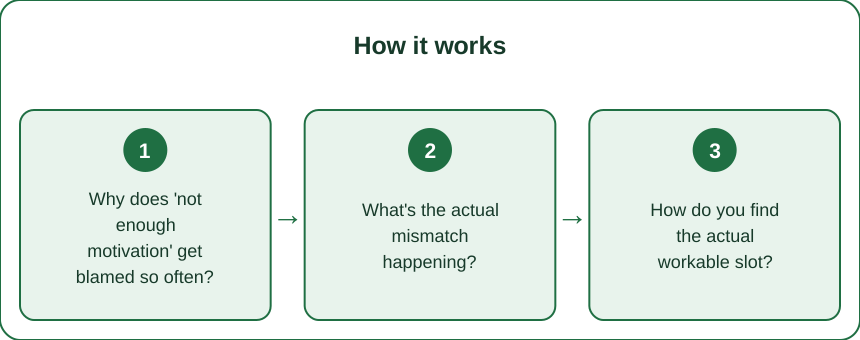
Why does ‘not enough motivation’ get blamed so often?
It’s the simplest explanation, and it feels honest — but motivation is highest in week one of any restart, which is exactly when most people quit. If motivation were the real problem, week one would be the hardest, not the easiest.
What’s the actual mismatch happening?
People restart using their old schedule — the 6am slot that worked two years ago, before a new job or a different sleep pattern. The workout time itself is often the wrong fit now, not the workout, and a slot that requires fighting your current life every single day eventually loses.
How do you find the actual workable slot?
Look at the last two weeks of your real calendar, not the ideal one. The time that’s already free most days — even if it’s not ‘optimal’ — beats a perfect-sounding slot you have to fight for. A mediocre time you’ll actually use outperforms a great time you’ll skip.

Does workout length matter as much as timing?
Less than people think. A 20-minute session at a time that fits beats a 60-minute session at a time that doesn’t, because consistency compounds and a skipped hour-long workout contributes zero, regardless of how good the plan was.
What Nobody Tells You About Restart Timing
Most restart advice focuses on the workout plan — reps, sets, programs — and almost none of it addresses when you’ll actually do it. The plan is rarely the reason restarts fail; the time slot is. Fixing the schedule mismatch solves more restarts than fixing the program ever does.
FAQ: Fitness Restart Questions, Answered
How long should a new workout time be tested before deciding it doesn’t fit?
Give it about two weeks — long enough to see if it’s a real pattern of skipping versus a rough couple of days.
Is it a problem to change the workout time again after a restart?
Not at all — adjusting the slot once you have real data on what your week looks like is normal, not a sign the restart failed.
Does working out at a less popular time (like midday) actually help consistency?
Sometimes, mainly because it avoids the gym-crowd or childcare bottlenecks that make ‘ideal’ times unreliable in practice.
TL;DR:
- Motivation is usually highest right when a restart begins, so low motivation rarely explains an early quit
- The real issue is often a workout time slot that no longer matches your current schedule
- A mediocre but realistic time beats a perfect but unrealistic one
- Shorter workouts at the right time beat longer ones at the wrong time
If a restart has stalled before, look at the clock before you look at the plan — the timing is usually the bigger fix.
Keep Reading
This article is for general informational purposes only and is not medical advice. Always consult a qualified health professional for guidance specific to you.