Why Your Restart Should Begin With a Schedule Audit, Not a Workout Plan
Quick Answer: Before you choose a program, map the five to seven windows in your week that already exist and stay open reliably. Most restarts collapse because a four-day plan was dropped onto a two-window week. Fit the plan to the calendar, not the calendar to the plan.
You have restarted before. You know the feeling of week one going perfectly and week three quietly disappearing.
The usual explanation is discipline. That explanation has never once helped you.
Here is a different one: you picked the program before you looked at the week it had to live in.

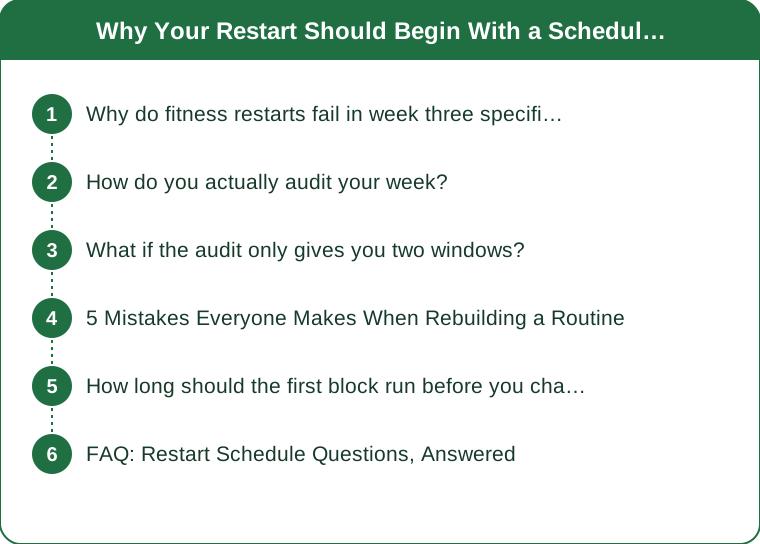
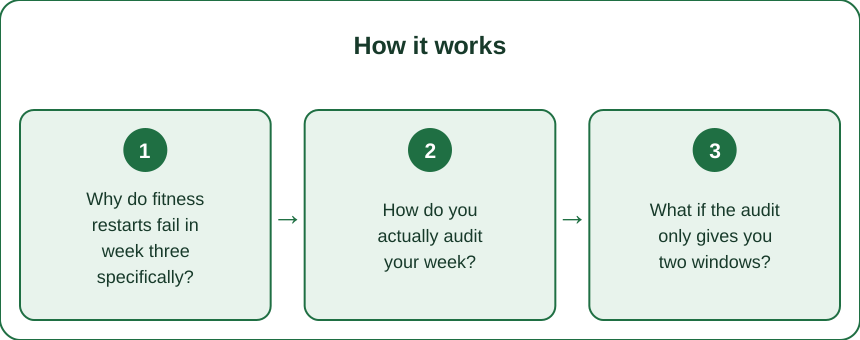
Why do fitness restarts fail in week three specifically?
Week one and two run on novelty. You rearrange things, you skip the dinner plan, you stay up late to make it work, and it feels like proof that you have changed.
Week three is when the borrowed time runs out. The thing you displaced comes back, and now the workout has to compete on equal terms with a real obligation.
The workout loses, because it was never scheduled — it was squeezed. A squeezed session survives only as long as your enthusiasm subsidizes it, and enthusiasm has a two-week half-life in almost everyone.
This is why the fix is structural rather than motivational. A session that sits in a window nothing else wants does not need to be defended every week.
How do you actually audit your week?
Take the last two weeks, not the ideal week. Open your calendar and write down, hour by hour, what genuinely happened on each day.
Now mark every block of 45 minutes or more that stayed empty both weeks. Not one week. Both. Those are your real windows, and there are usually fewer than you expect — most people find three to five.
A window only counts if it passes three tests. It repeats weekly, it does not depend on someone else’s schedule holding, and you are not already exhausted when it arrives.
A 6 a.m. window is real if you have woken at 6 a.m. on your own twice in the past two weeks. If you have not, it is a wish, and wishes are the most common failure point in a written plan.
What if the audit only gives you two windows?
Then you train twice a week, and you build the plan around that honestly instead of writing four days and hitting two.
Two full-body sessions a week is not a consolation prize. For someone coming back after months off, two well-run sessions of 45 minutes each — 5 to 6 compound movements, 3 sets of 8, 90 seconds rest — will produce visible strength change within six weeks.
The difference between a two-day plan you complete and a four-day plan you half-complete is not the volume. It is the identity. One of them ends each week with evidence that you do this. The other ends each week with a small deficit that compounds into quitting.
Give yourself the version you will finish.

5 Mistakes Everyone Makes When Rebuilding a Routine
1. Scheduling around your best week. You plan for the week where nothing goes wrong. Plan for the median week instead — the one with a late meeting and a bad night of sleep.
2. Putting the hardest session on Monday. Monday is the most frequently disrupted day in most calendars. Put your most important session mid-week where it is least likely to be displaced.
3. Counting travel time as zero. A 45-minute session at a gym 20 minutes away is a 90-minute commitment. Audit the commitment, not the workout.
4. Booking back-to-back with something that runs late. If the block before your window regularly overruns by ten minutes, your window is not the length you think it is.
5. Not writing down what the session displaces. Every new hour comes out of an existing hour. If you cannot name what you are giving up, you have not actually made room — and the third mistake here surprises people who consider themselves organized.
How long should the first block run before you change anything?
Six weeks, unchanged. Not because six weeks is magic, but because it is long enough to see whether the schedule holds under normal turbulence.
Track one number only: sessions completed out of sessions planned. Not weight, not soreness, not how you looked. Attendance.
If you finish six weeks above 85 percent, the schedule works and you have earned the right to add a day. If you land between 60 and 85 percent, the schedule is close — find the one window that keeps failing and move it rather than rewriting everything.
Below 60 percent means the audit was optimistic. Cut a day and run six more weeks. Nobody has ever regretted building on a foundation that held.
FAQ: Restart Schedule Questions, Answered
Should I restart in September or wait for January?
September is structurally better for most people. Schedules re-form around school and work calendars in early fall, which means new windows genuinely open — and you get four months of practice before the January crowd arrives.
What if my schedule changes every week?
Then anchor to events rather than clock times. Train immediately after a fixed weekly obligation instead of at a fixed hour. Shift workers and parents of young kids do far better with event anchors than time anchors.
Is a 20-minute session worth scheduling?
Yes, if it is the honest window. Twenty minutes of three compound lifts done twice a week beats a 60-minute plan attended once a month. Short and kept outperforms long and theoretical every time.
TL;DR:
- Audit the last two real weeks and find blocks that stayed open in both — those are your only true windows.
- Match the program to the window count you found, even if that number is two.
- Track attendance for six weeks before changing anything, and adjust the failing window rather than the whole plan.
- Anchor to events instead of clock times if your week is irregular.
Restarting is not a willpower problem wearing a scheduling costume. It is a scheduling problem that keeps getting treated as willpower. Spend the first hour of this restart with your calendar instead of a program, and the sixth week will look very different from every sixth week you have had before.
Keep Reading
This article is for general informational purposes only and is not medical advice. Always consult a qualified health professional for guidance specific to you.