Why Restarting After a Holiday Is Easier Than Restarting After a Busy Month
Quick Answer: After a holiday you are rested — sleep debt cleared, stress low, motivation genuinely restored — and the only thing you lost was a little fitness, which comes back fast. After a busy month you are depleted: the same lost fitness plus accumulated fatigue, worse sleep, and the same stressors still running. That is why identical breaks produce completely different returns, and why the busy-month restart needs a smaller first week, not a bigger one.
Most people plan the same comeback for both.
That is why one of them works.

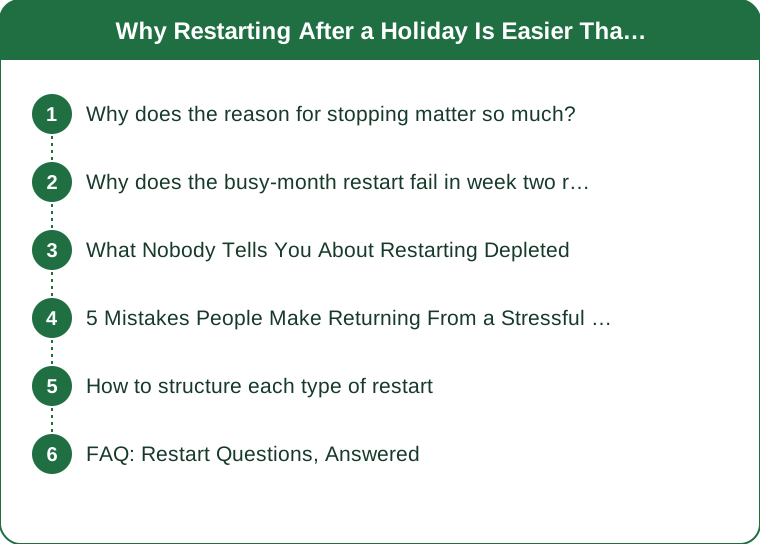
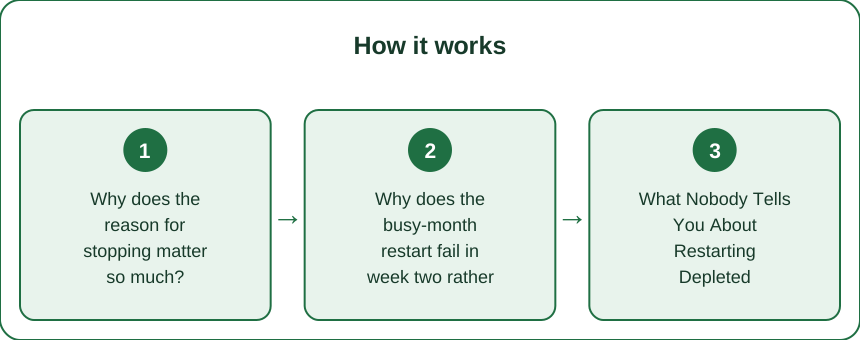
Why does the reason for stopping matter so much?
Because it determines what state you are in when you come back, and state is most of it.
A break has two components: the detraining — the fitness you actually lost — and the condition you are in when you return. People plan around the first and are ambushed by the second.
Detraining is reasonably predictable. Over two to four weeks off, strength holds up remarkably well; cardiovascular fitness declines faster but a good deal returns within a couple of weeks of restarting. Two weeks is not a disaster in either case, and the muscle memory effect means what you had comes back considerably faster than it was built.
Condition is the variable. After a holiday: rested, low stress, sleeping well, actively wanting to move. After a busy month: sleep-deprived, stressed, and returning to the same schedule that squeezed training out in the first place.
So the physical starting point is similar and the recovery capacity is not. Recovery capacity is what determines how much training you can absorb.
Why does the busy-month restart fail in week two rather than week one?
Because week one runs on intention and week two runs on recovery.
The first week back is usually fine. You are motivated, the sessions feel good, and the soreness feels like evidence. It confirms the decision.
Week two is when the bill arrives. You have added training stress to a system that was already carrying accumulated fatigue, and there was no surplus to absorb it. The sessions feel harder than week one, sleep does not improve, and the schedule that pushed training out last month is still exactly as it was.
This is the well-documented pattern where restarts fail in week two or three rather than at the start, and it is much more common after a stress break than a rest break. After a holiday, week two is usually easier than week one because you were rested going in and the initial soreness has passed.
Same programme, opposite trajectory, entirely because of what you brought with you.
What Nobody Tells You About Restarting Depleted
The soreness is worse and it lasts longer. Recovery from unaccustomed training depends on sleep and general recovery capacity. Restart depleted and the same session produces more soreness for more days — which then interferes with the next session, which compounds.
Motivation after a busy month is a different substance. Post-holiday motivation is genuine enthusiasm. Post-busy-month motivation is often guilt, and guilt is a much poorer fuel — it drives an aggressive first week and provides nothing when the first week is hard.
And the part almost nobody says: if the busy month is still going, you are not restarting. You are adding a demand to an overloaded system and calling it a fresh start. Sometimes the correct move is to fix the sleep and the schedule for one week first, with no training at all, and then begin. That feels like doing nothing and is often the single most effective week of the whole comeback.

5 Mistakes People Make Returning From a Stressful Period
1. Planning the comeback around the holiday version of themselves. Four sessions a week is a rested person’s plan.
2. Going hard in week one because it feels fine. It feels fine because you have not paid for it yet.
3. Returning to the exact programme they left. That programme was built for a person with a different schedule and more recovery than you currently have.
4. Treating sleep as something to fix later. Sleep is the input that determines how much training is useful. Fixing it first is not a delay; it is the first step.
5. Judging the return by how the first week felt. The third week is the honest one — if you are still there and the sessions still feel manageable, the plan was right.
How to structure each type of restart
They genuinely need different plans.
After a holiday or planned rest:
- Start at roughly 70% of your previous volume and build over two to three weeks
- Three or four sessions in week one is realistic
- Expect week two to feel better than week one
- You can be moderately ambitious; the recovery capacity is there
After a busy or stressful month:
- Start at roughly 50% of previous volume, or lower
- Two sessions in week one, and make them shorter than you want
- Add walking rather than intensity for the first fortnight
- Prioritise sleep above every training variable
- Expect week two to feel harder, and plan for that rather than being surprised
- Only increase once you have had two consecutive good weeks
And for both: plan the week you will miss. Something will come up. Deciding in advance what happens then — a shorter session, a walk, or simply skipping without consequence — is what separates a restart that survives a disruption from one that ends at it.
This is general information, not personalised training advice.
FAQ: Restart Questions, Answered
How much fitness do I actually lose in a month?
Less than it feels like. Strength is largely retained over four weeks; cardiovascular fitness declines more noticeably but recovers quickly. The bigger loss is usually in the habit and the routine, not the physiology.
Should I test where I am on the first session back?
No. A max-effort test on week one is the fastest route to a week of soreness and a failed week two. Test after three or four weeks back, when the number will also be more informative.
Is it better to restart with something different?
Often, yes — particularly after a stress break. A new format can carry you past the point where the old programme’s associations with your last failure kick in. It also removes the temptation to pick up at the weight you left off.
What if the busy period has not ended?
Then scale to what genuinely fits, which may be two twenty-minute sessions a week. That is not a compromise; it is the plan that survives. Consistency at a low volume beats an ambitious plan that ends in a fortnight.
TL;DR:
- The break costs you similar fitness either way; what differs is the state you return in
- Post-holiday you have recovery capacity; post-busy-month you do not
- Depleted restarts fail in week two, when the accumulated cost arrives
- Start at 70% of previous volume after a rest, 50% or less after a stressful period
- Fix sleep before adding training, and plan in advance for the week you will miss
If your last few comebacks have died in the second week, the plan was probably not too small — it was sized for someone who had just had a holiday. Halve the first fortnight and see how different the third week looks.
Keep Reading
This article is for general informational purposes only and is not medical advice. Always consult a qualified health professional for guidance specific to you.