How Sore You Should Actually Expect to Be When Restarting Fitness
Quick Answer: Mild to moderate soreness lasting 24 to 72 hours is a normal and expected part of restarting fitness after a break, especially in the first one to two weeks, while sharp pain, soreness that worsens instead of fading, or soreness that limits basic movement are signs to scale back rather than push through.
A restart that produces zero soreness at all is probably too easy, but one that leaves you unable to walk down stairs for four days has likely overshot the mark.

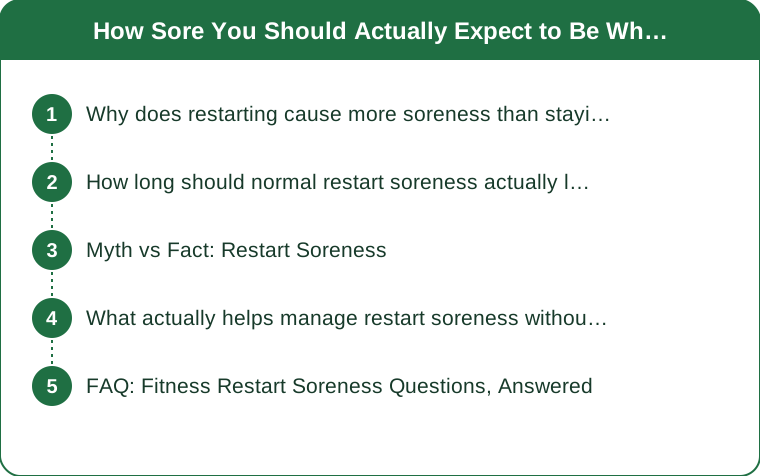
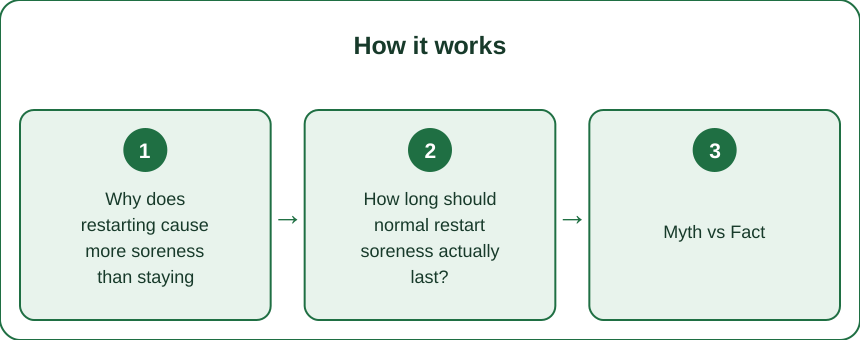
Why does restarting cause more soreness than staying consistent?
Muscles that haven’t been challenged in a while lose some conditioning to the specific stress of exercise, even if strength returns relatively quickly once training resumes.
This mismatch — muscles capable of more effort than they’re conditioned to recover from smoothly — is exactly what produces the exaggerated soreness so many people notice in their first week back.
How long should normal restart soreness actually last?
Typical delayed-onset soreness peaks around 24 to 48 hours after a session and meaningfully fades by 72 hours, even when it’s more intense than soreness from a regular training routine.
Soreness that’s still severe or getting worse past the 72-hour mark, rather than gradually improving, is worth treating as a signal to dial back intensity rather than pushing through.

Myth vs Fact: Restart Soreness
Myth: more soreness always means a more effective workout. Fact: soreness is a rough indicator of novel stress, not directly correlated with how effective or productive a session actually was.
Myth: pushing through severe soreness builds toughness faster. Fact: training through unresolved soreness increases injury risk and can extend recovery time rather than speeding progress.
What actually helps manage restart soreness without stopping progress?
Starting at roughly 50 to 60 percent of previous training intensity in the first week or two lets the body reacclimate without the most extreme soreness spikes.
Light movement like walking, along with adequate protein and sleep, genuinely speeds soreness recovery more than complete rest does in most cases.
FAQ: Fitness Restart Soreness Questions, Answered
Is it safe to train again while still sore from the last session?
Light to moderate soreness is generally fine to train through at reduced intensity, but sharp or joint-related pain is a signal to wait.
How many weeks does it usually take for soreness to normalize?
Most people notice a significant drop in restart-related soreness within two to three consistent weeks back.
Does stretching before a workout prevent this kind of soreness?
Not reliably — soreness from novel training stress isn’t primarily prevented by pre-workout stretching, though a proper warm-up still matters for performance and injury prevention.
TL;DR:
- Mild to moderate soreness lasting 24-72 hours is a normal part of restarting
- Soreness that worsens past 72 hours or limits basic movement is a signal to scale back
- Starting at reduced intensity in week one meaningfully lowers extreme soreness
- Light movement, protein, and sleep help recovery more than complete rest
Expect some soreness on a restart — just make sure it’s the kind that fades, not the kind that lingers.
Keep Reading
This article is for general informational purposes only and is not medical advice. Always consult a qualified health professional for guidance specific to you.