Why Restarting a Fitness Routine Can Feel Harder the Third Time Than the First
Quick Answer: While muscle memory genuinely does make a physical comeback faster with each prior training history, repeated stop-start cycles can build a psychological pattern of self-doubt and anticipated failure that works against that physical advantage — this means the third restart can feel emotionally harder even while being physically easier, because the mental burden of “here we go again” compounds in a way the body’s actual comeback capacity doesn’t.
A harder-feeling third restart isn’t a sign of declining fitness capacity — the body’s comeback ability is usually still intact or improved, while it’s the accumulated psychological weight of prior stops that’s actually doing the work of making it feel harder.

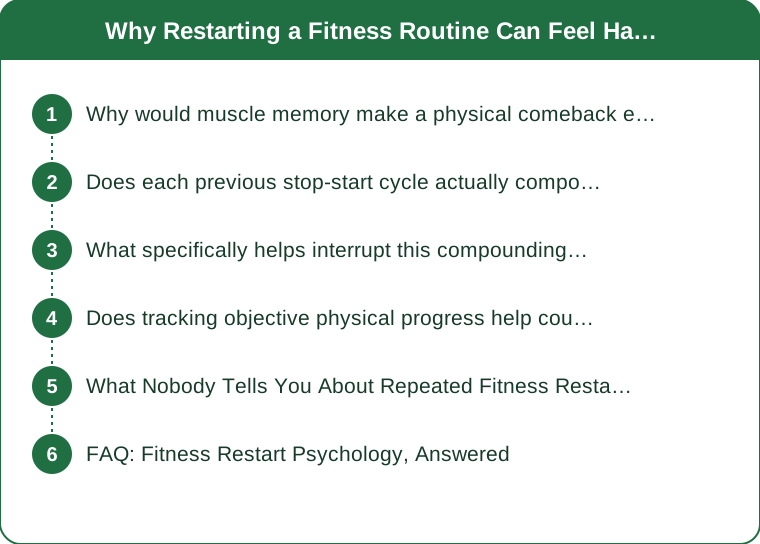
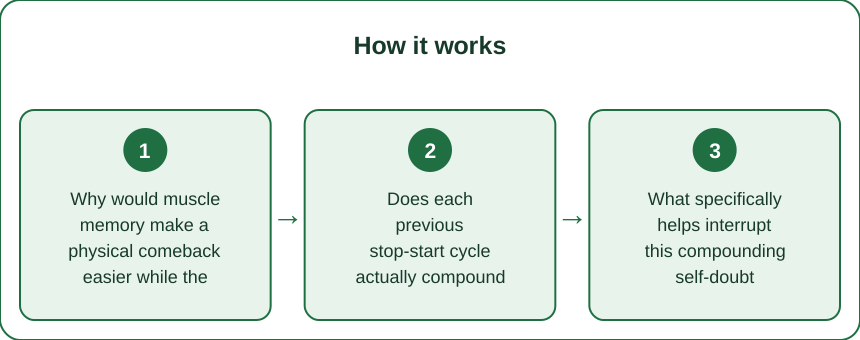
Why would muscle memory make a physical comeback easier while the experience still feels harder overall?
Muscle memory operates at a cellular and neuromuscular level, largely independent of psychological state — previously trained muscle fibers and movement patterns genuinely do reactivate and rebuild strength faster than a true first-time start would. But motivation, confidence, and habit formation operate through a completely separate psychological system, and repeated past stops can erode confidence in this system even while the physical system remains genuinely advantaged.
Does each previous stop-start cycle actually compound psychologically, or does each restart begin fresh mentally?
For many people, it compounds rather than resetting fresh — each prior instance of starting strong and then stopping can build an anticipatory expectation of eventual failure, sometimes described as a self-fulfilling pattern, where the mental script of “I’ll probably stop again” undermines commitment before physical fatigue or scheduling difficulty even becomes a factor. This compounding is a learned psychological pattern, not an inevitable consequence of restarting.
What specifically helps interrupt this compounding self-doubt pattern on a new restart attempt?
Explicitly identifying what caused previous stops (not vague willpower failure, but a specific, addressable cause like an unsustainable schedule or too-aggressive intensity) and changing that specific factor this time helps break the pattern, since it gives a concrete reason to expect a different outcome rather than repeating an identical setup and hoping for a different result. Setting a smaller, genuinely sustainable initial goal rather than an ambitious comeback pace also reduces the setup for another discouraging stop.

Does tracking objective physical progress help counter the psychological discouragement specifically?
Yes, often significantly — because muscle memory produces genuinely faster physical progress this time around, keeping simple, objective records (weights lifted, distance covered, workout consistency) gives concrete evidence that directly contradicts the psychological narrative of “it’s not working” or “I’m just not someone who sticks with this,” replacing an emotional impression with visible, factual counter-evidence.
What Nobody Tells You About Repeated Fitness Restarts
The fact that someone keeps restarting at all, despite the accumulated psychological discouragement, is itself a meaningful positive signal often overlooked — treating a third restart attempt as a sign of failure ignores that persistence through discouragement is a real, valuable trait, and reframing each restart as evidence of that persistence, rather than evidence of repeated failure, changes the psychological framing in a way that supports actually sticking with this attempt.
FAQ: Fitness Restart Psychology, Answered
Does working with a coach or trainer specifically help address this psychological restart pattern?
Yes, often significantly — outside accountability and a structured, realistic plan can directly counter both the practical causes of past stops and the psychological self-doubt pattern that’s built up.
Is it useful to reflect specifically on what was different about attempts that did stick, even briefly, compared to ones that didn’t?
Yes — identifying specific conditions (time of day, workout type, social support) present during more successful past periods offers concrete, personalized guidance for structuring the current restart more sustainably.
Does this compounding discouragement pattern eventually stop happening with enough successful restarts?
Yes, generally — each successful sustained period, even if eventually interrupted by a legitimate life circumstance, gradually builds a more balanced self-narrative that counters the earlier pattern of anticipated failure.
TL;DR:
- Muscle memory gives genuine physical comeback advantages that remain intact across repeated restarts
- Repeated past stops can build a compounding psychological pattern of anticipated failure, separate from physical capacity
- Identifying the specific past cause of stopping, rather than blaming willpower, helps break that pattern
- Tracking objective progress provides concrete evidence that counters the discouraging psychological narrative
A third fitness restart feeling harder reflects accumulated psychological weight, not declining physical capacity — addressing that mental pattern directly is what actually determines whether this restart sticks.
Keep Reading
This article is for general informational purposes only and is not medical advice. Always consult a qualified health professional for guidance specific to you.