Plan the Week You Are Going to Miss — Before It Happens
Quick Answer: Write a minimum version of your week — usually two sessions of 20 minutes — and decide in advance that it replaces the plan whenever life interferes. A plan with a defined floor survives disruption; a plan with only a full version fails completely the first time a week goes wrong.
The plan is good. Week one and two go exactly as written.
Week five brings a work trip, a cold, and a family thing, and the plan has no version of itself that fits.

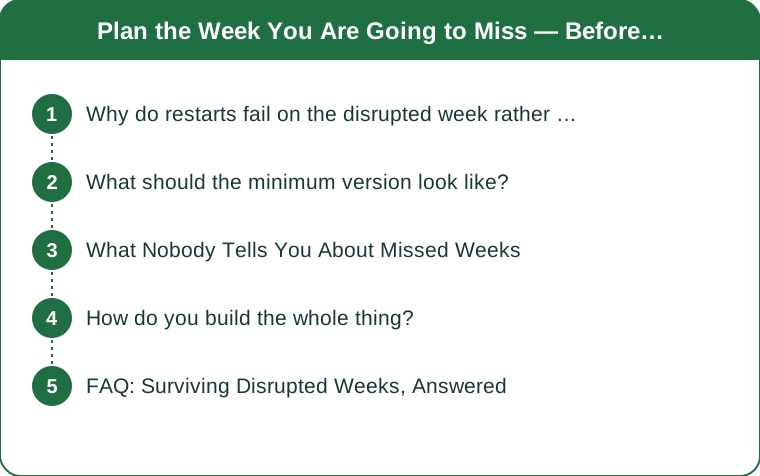
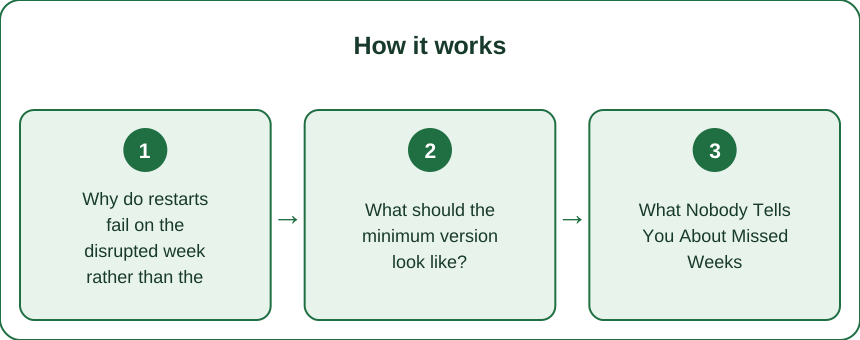
Why do restarts fail on the disrupted week rather than the hard week?
Because the plan has no smaller version, so missing it means abandoning it.
All-or-nothing plans have exactly one failure mode. If four sessions a week is the plan, then two sessions is not 50 percent success — it registers as failure, and failure is what people stop doing.
The identity story breaks before the fitness does. Two weeks off costs very little physically. What it costs is the sense of being someone who trains, and that is the thing that is hard to rebuild.
Restarting is more expensive than continuing at a reduced level. The friction of week one — deciding, scheduling, the first uncomfortable session — is much higher than the friction of a 20-minute maintenance session during a hard week.
Disruption is not an exception; it is a feature of every calendar. Illness, travel, work crunches, family. Over a year you should expect six to ten disrupted weeks. A plan that assumes none of them is a plan for a year that does not exist.
Week three to five is the usual failure window. Early enthusiasm has faded and the habit is not yet automatic, so the first disruption lands at the worst possible time. This is predictable enough to prepare for specifically.
What should the minimum version look like?
Small enough that you would be embarrassed to skip it.
Two sessions, 20 minutes each, no equipment required. That is the shape most people find sustainable in a genuinely bad week. It maintains strength adequately and it keeps the habit alive, which is its actual job.
Write it down before you need it. The specific exercises, the specific length. Deciding what a minimum session looks like while you are already overwhelmed produces no session at all.
Make it location-independent. A hotel room, a living room, a small patch of floor. If the minimum version requires the gym, the week that removes the gym removes the plan.
Give it a name and treat it as a real option. Not ‘the failure version’ — the travel week, the sick week, the deadline week. Framing decides whether you use it.
Set the trigger in advance. For example: if I miss two planned sessions in a row, I switch to the minimum for the rest of the week and return to the full plan on Monday. A pre-set rule removes the negotiation entirely.

What Nobody Tells You About Missed Weeks
Two weeks off costs far less than you fear. Meaningful strength loss takes longer than most people assume, and what you lose returns quickly. The physical cost of a bad fortnight is genuinely small.
The first session back is the whole problem. It feels harder than it is, and that sensation is what people interpret as having lost everything. Expecting it removes most of its power.
Coming back at 60 percent is the correct move. The instinct is to make up for lost time, which produces soreness that costs another week. Half your usual load for the first session back is the boring, effective approach.
People who have restarted several times succeed faster. Each attempt teaches you where your plan breaks. Someone on their fourth restart typically knows which week fails and why, and that information is genuinely valuable rather than evidence of failure.
Planning for failure does not invite it. The concern that a minimum version becomes the default is understandable and mostly unfounded — in practice, having a floor means people return to the full plan sooner, because they never fully stopped.
How do you build the whole thing?
Three components, written down before week one.
The full plan. What you do in a normal week, with days assigned. This is the part everyone writes.
The minimum plan. Two sessions, 20 minutes, no equipment, specific exercises listed. This is the part almost nobody writes and the part that determines whether the restart survives.
The trigger and the return date. What tells you to switch down, and when you switch back. Both specific: two missed sessions triggers it, and the following Monday returns you.
Put all three on one page where you can see it. A plan in your head has no minimum version, because the mind does not negotiate well at 9pm on a bad Tuesday.
Review after the first disrupted week. Did the minimum version get used? If not, it was too big. Twenty minutes is a starting guess, not a rule — some people need ten, and ten used beats twenty ignored. If you are returning after illness or injury, build the return with a clinician rather than a rule of thumb. This is general information, not medical advice.
FAQ: Surviving Disrupted Weeks, Answered
How much fitness do I actually lose in two weeks off?
Very little. Strength is largely retained across a two-week break and returns quickly afterward. Cardiovascular fitness declines somewhat faster but also rebuilds fast. The real cost is the habit, not the adaptation.
Won’t a minimum plan just become my new normal?
Rarely, in practice. The minimum is uncomfortable in a different way — it does not feel like enough — which is precisely what motivates the return to the full plan. Having a floor generally shortens disruptions rather than extending them.
When in a restart should I write the minimum plan?
Week one, alongside the full plan. Writing it during the disrupted week does not happen — that week has no spare capacity for planning, which is the entire reason the plan needs to already exist.
TL;DR:
- Restarts fail on disrupted weeks because the plan has no smaller version to fall back to.
- Write a minimum plan in week one: two 20-minute sessions, no equipment, location-independent.
- Set the trigger and the return date in advance so there is nothing to negotiate on a bad Tuesday.
- Come back at 60 percent — making up lost time produces soreness that costs another week.
Everyone misses weeks. The only difference between a pause and another restart is whether you decided in advance what the missed week looks like.
Keep Reading
This article is for general informational purposes only and is not medical advice. Always consult a qualified health professional for guidance specific to you.