Why the Workout You Pick for Day One Decides Whether There Is a Day Four
Quick Answer: After a break, the first workout produces disproportionate soreness because your muscles have lost their protective adaptation to that specific movement. A hard day one means peak soreness lands on day two or three - precisely when session two was scheduled - and the restart stalls before it has a pattern. Make day one roughly half of what you think you can handle, keep it under thirty minutes, and put the second session forty-eight hours later. Day one is not for progress; it is for making day four possible.
You felt great on day one, which is exactly the problem.
Soreness has a delay, and the plan was built before the bill arrived.

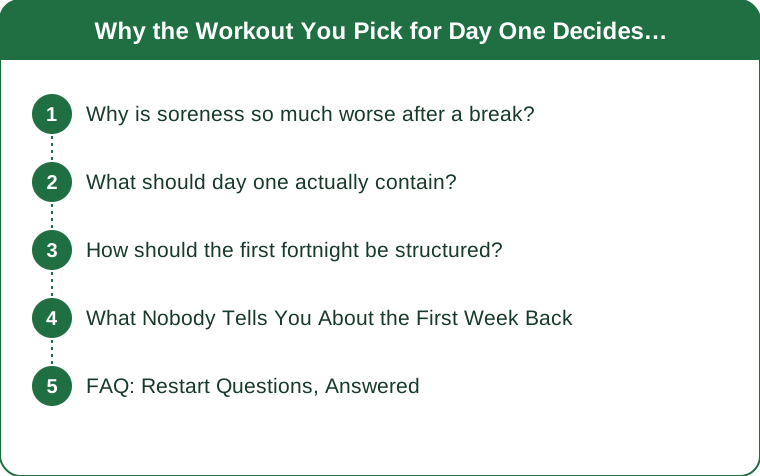
Why is soreness so much worse after a break?
Muscle develops a protective adaptation to a movement it performs regularly, and that adaptation fades over weeks without the stimulus.
This is why a session you handled easily three months ago can produce days of soreness now, even though the weights are the same and you have not lost much strength.
Delayed onset muscle soreness typically peaks around 24 to 72 hours after the session, which means day one feels deceptively fine.
Eccentric loading drives it hardest - lowering weights, running downhill, the descent of a squat or lunge. A first session full of eccentric work is a first session with a large delayed bill.
The good news is the repeated bout effect: the second exposure to the same movement produces dramatically less soreness, and it arrives fast.
So the first two sessions are the entire cost. Getting through them intact is most of the restart problem, and overshooting day one is what stops people paying it.
What should day one actually contain?
Roughly half the volume you believe you can do. Not half the intensity - half the amount.
Under thirty minutes, including warm-up. Duration is the variable people overshoot most and notice least.
Full body, light, with the emphasis on movement quality rather than load. Two sets where you would normally do four.
Deliberately limit the eccentric work. Slow controlled lowering is excellent training and a poor choice for the first session back.
Finish while you still want to keep going. This is the single most useful rule, and it feels wrong every time.
Walk afterwards for ten minutes rather than sitting straight down.
And write down exactly what you did, because session two should be a near-copy of it rather than an escalation.

How should the first fortnight be structured?
Session two, forty-eight hours after session one, and near-identical. The repeated bout effect means it will feel substantially easier despite being the same work.
Three sessions in week one, three in week two, at roughly the same size. Resist adding anything.
Add volume in week three, not week two. Two full weeks of a repeatable pattern before progressing is the part people skip.
Keep it at a fixed anchor point in the day, since the pattern matters more than the content at this stage.
Expect week two to feel psychologically worse than week one - the novelty has gone and the results have not arrived. This is documented and normal.
Walking on the non-training days does more for consistency than an extra session would, and it does not add soreness.
And leave the old program alone. The program you were running before the break was built for a version of you with accumulated adaptation.
What Nobody Tells You About the First Week Back
Feeling capable on day one is not evidence you should do more. Strength returns faster than tissue tolerance does, so your ability to perform a session outruns your ability to recover from it for the first few weeks. That gap is exactly where restarts die.
The second session is the one that determines whether this becomes a habit, and it is the one most likely to be cancelled by day-one soreness. Design day one backwards from it.
Muscle memory is real and it works in your favour. Previously trained muscle regains size and strength considerably faster than it was originally built, which means an easy start costs you far less than it feels like it does.
Soreness is a poor measure of session quality. A session that leaves you sore for four days was not four times as productive as one that left you fine the next morning - it was mostly novel eccentric loading.
Cardio comes back faster than joints and tendons do. Connective tissue adapts on a slower timescale than the cardiovascular system, so feeling fit is not the same as being ready for volume.
Most people restart in a week that is already busy, because motivation tends to arrive alongside some other change. Half the design work is scheduling, not programming.
And the third or fourth restart genuinely goes better than the first two - not because of willpower, but because you know which specific week you tend to quit in.
FAQ: Restart Questions, Answered
How hard should my first workout back be?
About half of what you think you can handle, under thirty minutes, finished while you still feel like continuing. Day one exists to make day four possible.
How long will the soreness last?
Peak soreness usually lands 24 to 72 hours after the session and resolves within a few days. The second exposure to the same movement produces far less - often dramatically less.
Should I train through soreness?
Light movement generally helps and walking is ideal. Repeating a heavy session on badly sore muscles is where people get hurt or quit. This is general information, not medical advice.
When can I go back to my old program?
Usually after three to four weeks of consistent easier training. The old program assumed adaptations that took months to build and weeks to fade.
Why does week two feel worse than week one?
Novelty has faded and visible results have not arrived. It is the most commonly reported drop-off point and it passes if the sessions stay small.
Does taking months off mean starting from zero?
No. Previously trained muscle regains strength and size much faster than it built them originally, which is why an easy start costs less than it feels like it should.
TL;DR:
- Post-break soreness peaks 24 to 72 hours later - right where session two was scheduled.
- Make day one half the volume you think you can do, under thirty minutes, and stop while you still want more.
- Put session two forty-eight hours later and make it near-identical; the repeated bout effect makes it far easier.
- Keep sessions the same size for two full weeks before adding anything.
- Limit heavy eccentric work in the first session - it drives most of the soreness.
- Muscle memory means an easy start costs you almost nothing.
Design day one backwards from day four. This is general information, not medical advice.
Keep Reading
This article is for general informational purposes only and is not medical advice. Always consult a qualified health professional for guidance specific to you.