Why Restarting in September Works Better Than January
Quick Answer: September restarts benefit from a genuine structural reset - schedules change, routines rebuild, and the fresh start effect applies just as strongly as it does in January. But unlike January it comes with better weather for outdoor activity, no post-holiday depletion, no shortest-days-of-the-year problem, and gyms that are not overcrowded. The obstacles that break January restarts are largely absent now. The timing advantage is structural, not motivational.
This is one of the rare cases where the popular timing is clearly the worse one.
And the better window is open right now.

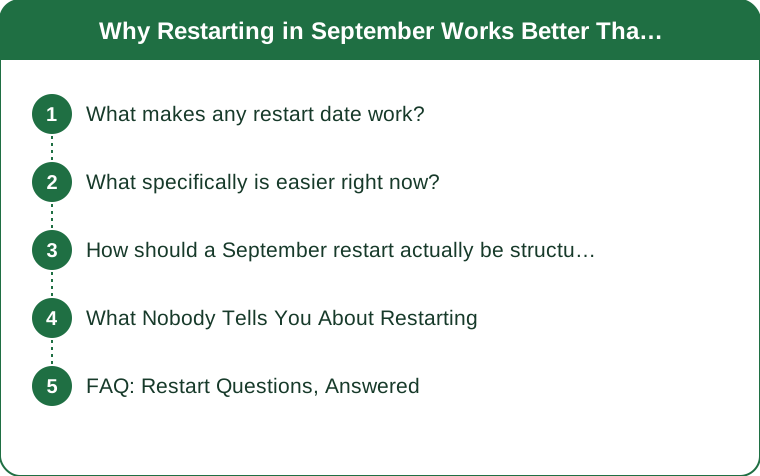
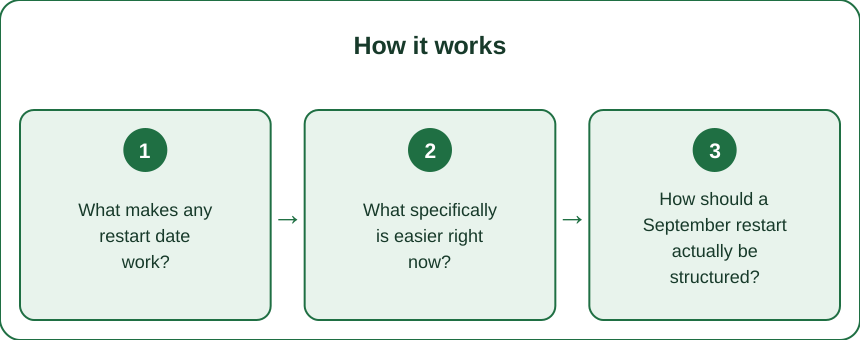
What makes any restart date work?
A temporal landmark plus favourable conditions - and January only has the first.
The fresh start effect is well documented in behaviour change research: people are more likely to pursue goals following temporal landmarks - a new year, a birthday, the start of a month, the start of a week. The landmark creates a psychological separation from a past self who failed, which makes a new attempt feel viable.
Critically, the effect is not specific to January. Any meaningful boundary works, and for anyone with school-age children, an academic connection, or a seasonally structured job, September is one of the strongest landmarks in the year.
Where January falls down is on conditions. The landmark is strong and everything else is hostile: the shortest days of the year, the coldest weather, post-holiday financial pressure, depleted energy after weeks of disruption, and gyms at their most crowded.
September inverts almost all of that. Comfortable temperatures for outdoor activity, plenty of daylight, schedules re-forming naturally, and quieter facilities.
The practical framing: motivation is roughly the same in both months. Friction is not. Restarts fail on friction far more often than on motivation, which is why the month with less of it wins.
What specifically is easier right now?
Six things, and they compound.
Daylight. There is still meaningful daylight before and after a standard workday, which makes outdoor activity possible without it being a project. By late December that window has closed completely for most people.
Temperature. Late summer into early fall is close to ideal for outdoor exercise - warm enough for minimal gear, cool enough that hard efforts are comfortable. Running in 60°F is objectively easier than running in 85°F or 30°F.
Schedule structure returns. Summer disrupts routines - travel, irregular hours, children at home. September restores predictable weekly structure, and habits attach to structure far more readily than to intention.
Facilities are quiet. Gyms in September are noticeably less crowded than in January, which removes a real practical obstacle - waiting for equipment is a genuine adherence problem, not a trivial complaint.
Food is at its best. Late-summer and early-autumn produce is at peak quality and lowest cost, which makes eating well easier and cheaper than at any other point in the year.
And there is no depletion to recover from. January follows several weeks of disrupted sleep, altered eating, and often financial strain. September follows a summer that, for most people, was restorative rather than depleting.
Six structural advantages, none of which require any additional willpower.

How should a September restart actually be structured?
Deliberately smaller than you want it to be, and attached to the structure that is already re-forming.
Pick two habits, not five. The most common restart failure is attempting a complete overhaul simultaneously - training, diet, sleep, alcohol, and screen time all at once. Two changes have a far higher survival rate at twelve weeks than five do.
Attach each one to something already fixed in the new schedule. Habits form more reliably when anchored to an existing routine than when scheduled by time alone. After the school drop-off. Before the first meeting. Immediately after work ends.
Start at roughly half of what you think you can sustain. The first four weeks are for establishing the pattern, not for producing results. If you think you can train four times a week, start with two and add later. This feels unsatisfying and dramatically improves the twelve-week outcome.
Use the weather while it lasts. Outdoor activity is easiest right now and will get harder every week from here. Building an outdoor habit in September and moving it indoors in November is far easier than the reverse.
Plan the November problem in advance. The clocks change, daylight disappears, and this is where September restarts break. Decide now what the indoor version looks like - the specific class, the specific home routine - rather than improvising in the dark.
And define what a bad week looks like before you have one. A minimum viable version - one session, ten minutes - keeps the chain alive through the weeks that would otherwise end it.
What Nobody Tells You About Restarting
Your third restart is different from your first. You know the failure points, which sounds like an advantage and often functions as discouragement. The useful reframe: previous attempts generated information. Knowing that you stop going after week five is actionable, where a first-timer has no idea.
Restarting is easier than starting, physiologically. Muscle memory is real - previously trained muscle regains size and strength faster than untrained muscle builds it. If you trained before, you will come back faster than you built it originally, and this effect persists for years.
The first two weeks feel disproportionately hard, then it flips. Weeks one and two are the worst ratio of effort to reward in the whole process. Knowing that in advance is worth a lot when you are in them.
Do not resume at your old program. The most common restart injury comes from a body that remembers the intensity and no longer has the tissue tolerance for it. Connective tissue adapts more slowly than muscle, and it does not have the same memory.
Nobody is watching. The self-consciousness of restarting is real and almost entirely internal. Everyone at the gym in September is either restarting themselves or focused on their own session.
And the calendar is a tool, not a rule. The fresh start effect works on any landmark - the first of the month, a Monday, a birthday. If you miss September, October the first works exactly the same way. Waiting for January is choosing the hardest available date.
FAQ: Restart Questions, Answered
How long until it feels normal again?
Two to three weeks for the initial resistance to fade, and roughly two months before it feels genuinely automatic. The often-quoted 21 days is a myth; research on habit formation suggests a median closer to two months with wide individual variation.
Should I start with diet or exercise?
Whichever is more attractive to you right now. Doing one well beats doing both badly, and the momentum from a successful first change makes the second one considerably easier. There is no correct order.
What if I have restarted five times already?
Then you have five sets of data about what breaks it. Look for the pattern - the week it stops, the circumstance that interrupts it, the habit that was too ambitious. Design around that specific failure point rather than trying harder at the same plan.
TL;DR:
- The fresh start effect works on any temporal landmark, and September is among the strongest of the year.
- January has the landmark and hostile conditions; September has the landmark and favourable ones.
- Daylight, temperature, returning structure, quiet gyms, and peak produce all reduce friction right now.
- Pick two habits, anchor them to existing routine, start at half what you think you can do.
- Plan the November version now, before the clocks change and the daylight goes.
Choose your two habits today and anchor each to something already in your week. That is the whole restart.
Keep Reading
This article is for general informational purposes only and is not medical advice. Always consult a qualified health professional for guidance specific to you.