Why Restarting With a Schedule Beats Restarting With a Goal
Quick Answer: A goal tells you where you want to end up and nothing about what to do on a Tuesday when you do not feel like it. A schedule specifies the behavior, the time, and the place, which removes the daily decision — and removing decisions is what makes a restart survive past the motivated phase.
Every restart begins with a number. Lose fifteen pounds, run a 10K, get back to three sessions a week. And every restart ends somewhere around week three, when the number stops being interesting and there is nothing else holding it up.

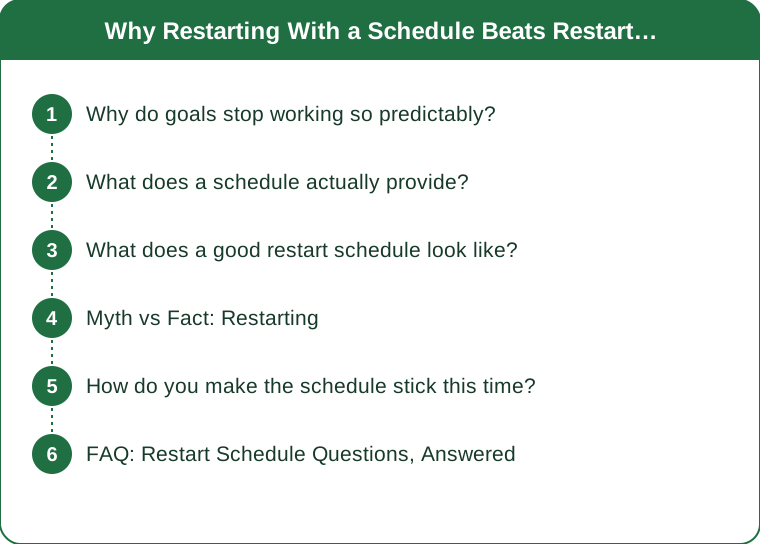
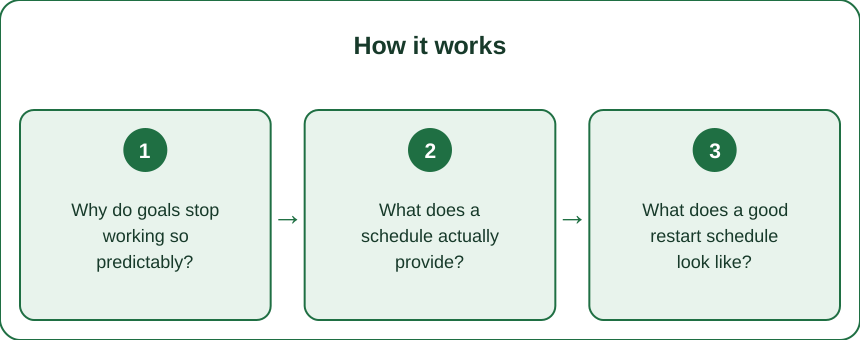
Why do goals stop working so predictably?
Because they operate on motivation, and motivation is a variable you do not control.
A goal generates enthusiasm at the start, when it is novel and the gap between where you are and where you want to be is exciting rather than tiring. That state is real and it is temporary. Novelty fades on a schedule of roughly two to three weeks for most people.
What a goal fundamentally does not provide is an answer to the question of what to do right now. “Lose fifteen pounds” gives you no instruction on a Tuesday evening when you are tired. You have to generate the decision yourself, every time, from a resource that is depleting.
There is a second problem specific to restarts: goals are usually set at the peak of motivation, which is the worst moment to calibrate anything. The person setting a five-day-a-week plan is the most enthusiastic version of you that will exist. The person executing it on a wet Thursday in week four is not.
So the goal is simultaneously too ambitious and insufficiently specific — a difficult combination.
What does a schedule actually provide?
Three things a goal does not.
A specified behavior. Not “exercise more” but “30 minutes of strength work.” The decision about what has already been made.
A time and a place. This is the piece that does most of the work. Research on implementation intentions — plans of the form “when situation X arises, I will do Y” — consistently finds they substantially improve follow-through compared with goal intentions alone. Attaching a behavior to a specific cue outsources the decision to the environment.
A default. When Tuesday at 6pm is training, the question is not whether to train but whether to skip. That reversal matters more than it sounds. The default option is what people choose when they lack the energy to choose, and a schedule makes the default the thing you wanted.
What you give up is flexibility, and it is worth naming that this is a real trade. A schedule is less responsive to how you feel on a given day. That is precisely the point — how you feel on a given day is exactly what has been sabotaging every previous restart.
What does a good restart schedule look like?
Smaller and more specific than you want it to be.
- Three sessions a week, not five. Three is achievable in a bad week, which means it survives a bad week. Five is achievable only in good weeks, and a restart that requires good weeks is a restart with an expiry date
- Fixed days and times, written where you will see them. Same slots each week
- A named session, not a category. “Full body A” beats “gym,” because “gym” still requires you to decide what to do when you get there
- A location and a bag. The physical setup is part of the schedule
- A minimum version of each session — 15 minutes, three exercises — that counts as done. The minimum version is what protects the schedule on the days it would otherwise break
- An explicit end date for review, six to eight weeks out. Open-ended commitments are harder to sustain than defined blocks
What is deliberately absent: any performance target. The first six weeks of a restart should have no numbers attached to outcomes, because outcome numbers reintroduce exactly the motivation dependency you are trying to escape.

Myth vs Fact: Restarting
Myth: You need a strong why to sustain a habit. Fact: A strong why helps you start and does little for consistency. What sustains behavior over months is low friction, a fixed cue, and an identity that comes to include the behavior. Plenty of people with excellent reasons do not train; plenty with unremarkable reasons train every Tuesday.
Myth: Goals give you something to work toward, which schedules do not. Fact: You can have both, and the sequencing matters. Set the schedule first and add the goal once the schedule is running. A goal layered onto an established schedule is motivating; a goal with no schedule underneath is a wish.
Myth: Missing a session ruins it. Fact: Research on habit formation finds that a single missed occasion has essentially no effect on eventual habit strength. What matters is what happens next. The schedule provides the answer automatically — the next slot is Thursday, and nothing about Tuesday changes that.
Myth: You should restart when you feel ready. Fact: Feeling ready is a motivational state, so waiting for it means starting at peak motivation, which is when people set unrealistic schedules. Starting from a neutral state produces more realistic plans.
How do you make the schedule stick this time?
Five practical moves, in order of how much they matter.
- Put it in the calendar as recurring events with alerts. Not a note, not an intention. The same status as anything else in your week
- Attach each session to something that already happens. After dropping the kids off, before the evening meal, straight after work before you sit down. Anchored sessions survive; floating ones do not
- Prepare the environment the night before. Bag packed, clothes out, plan written. Reducing friction on the day is worth more than any amount of resolve
- Track attendance, not performance. A simple mark on a calendar for each completed session. What you are building in weeks one to six is the schedule itself, and that is what should be measured
- Review at week six, not before. Then, and only then, look at whether to add a session, add a goal, or change the plan
One seasonal note worth acting on: September is genuinely a better restart window than January. Routines are re-forming after summer, schedules are more predictable, the weather is good for outdoor work, and there is far less collective pressure than there is in January — which means fewer unrealistic plans and less to compare yourself against. Setting the schedule in the last weeks of August means it is established before the season turns properly.
FAQ: Restart Schedule Questions, Answered
What if my week is genuinely unpredictable?
Then anchor to events rather than clock times — after the school run, before dinner, first thing on any day you work from home. The cue needs to be reliable, not the hour. Two anchored sessions beat four scheduled ones you cannot honor.
How long until it stops requiring effort?
Research on habit formation suggests a wide range, commonly cited around two to three months on average with substantial individual variation. What that means practically: expect it to require deliberate effort for longer than the popular three-week figure suggests, and plan the schedule to survive that period rather than assuming it becomes automatic quickly.
When should I add the goal back in?
Once you have six to eight consecutive weeks of hitting the schedule. At that point a goal becomes a useful direction rather than the thing holding the whole structure up, and you will set a far more realistic one from a position of established consistency.
TL;DR:
- Goals run on motivation, which fades on a predictable timeline and tells you nothing about Tuesday
- A schedule specifies behavior, time, and place — which removes the daily decision entirely
- Three anchored sessions with a defined minimum version beats five ambitious ones
- Track attendance for six weeks, add the goal only once the schedule holds
The restart that works is usually the least exciting one you have ever planned. That is not a coincidence — the excitement was always the part with the expiry date.
Keep Reading
This article is for general informational purposes only and is not medical advice. Always consult a qualified health professional for guidance specific to you.