Why Restarting With Someone Else Changes Where It Fails
Quick Answer: Training with someone else reliably solves the showing-up problem, because a scheduled meeting is much harder to skip than a personal intention. It does not solve pacing, program design, or the tendency to start too hard — and it can make those worse, because two people restarting together tend to push each other beyond what either would choose alone. If your restarts die from not showing up, a partner is the highest-value change available. If they die in week three from doing too much, a partner may accelerate it.
Know which failure is yours before deciding.

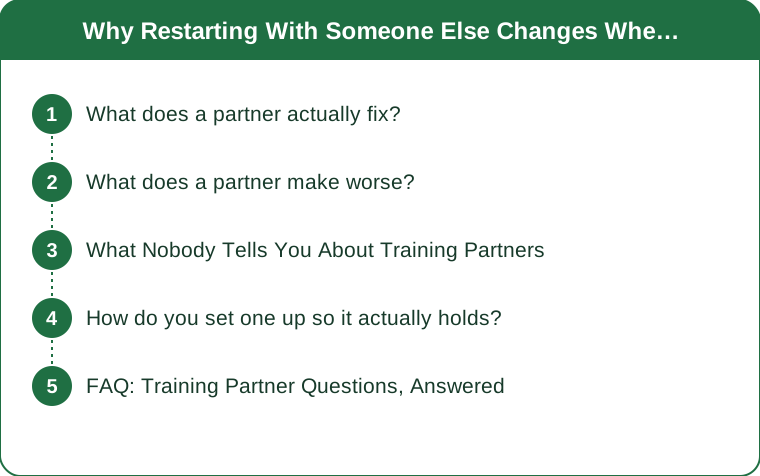
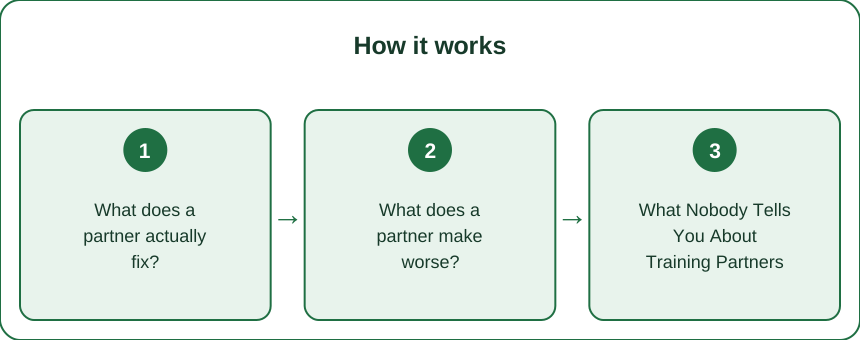
What does a partner actually fix?
Attendance, and attendance is a big deal.
Most restarts do not fail dramatically. They fail through a series of individually reasonable skips — a busy Tuesday, a late meeting, a bad night’s sleep. Each skip is defensible, and four of them in a row is a stopped habit.
A scheduled session with another person changes the calculation. Skipping now has a social cost, and it requires a message rather than a silent decision. That small friction is enough to convert a large share of would-be skips into attended sessions.
There is a second, less obvious benefit. A partner fixes the decision fatigue problem. Deciding when to train, what to do, and whether today is the day is a daily cognitive cost, and it is the cost that quietly wears people down in week two and three. A fixed appointment with someone else removes the decision entirely.
There is also the simple matter of the session being more pleasant. Time passes faster, effort is less noticeable, and a walk or a class with a friend is an activity rather than a chore.
The research on social support in exercise adherence is fairly consistent — people who train with others tend to stick with programs longer than those training alone. The mechanism is mostly attendance rather than motivation, which is worth being clear about, because it tells you what a partner cannot fix.
What does a partner make worse?
Pacing, and pacing is what kills week three.
Two people restarting together generate a specific dynamic. Neither wants to be the one who suggests going easier. Neither wants to stop first. The session naturally settles at the harder of the two people’s inclinations, not the easier one.
For a restart, this is precisely the wrong direction. The most common cause of a failed comeback is not insufficient effort — it is excessive effort in the first two weeks producing soreness, fatigue, or a minor injury that ends the attempt.
The fitness gap makes it worse. If one person is further along, the sessions calibrate to them, and the other is training above their appropriate intensity every time. This is the single most common way a well-intentioned partnership breaks down: not through conflict, but through one person quietly finding it unsustainable.
There is a schedule fragility issue too. Two schedules have more failure points than one. When your partner’s week falls apart, so does yours, and a partnership can produce a total stop where a solo attempt would have produced a reduced week.
And there is a dependency risk. If the habit is attached to a person rather than to your own routine, it does not survive that person moving, changing jobs, or losing interest. A habit that requires someone else is more fragile in the long run, even if it is more robust in the first month.

What Nobody Tells You About Training Partners
A walking partner is more durable than a gym partner. Walking requires no booking, no facility, and no equipment, and it accommodates a fitness gap effortlessly because you can talk at any pace. The most successful long-term partnerships are usually built around walking.
Matching schedules matters more than matching fitness. A partner whose availability aligns with yours is worth far more than one at your exact level whose availability does not.
Agreeing to go easy has to be explicit and stated out loud. Both people usually want to go easier and neither will say so. Deciding in advance that the first three weeks are deliberately conservative removes the social cost of being the one to suggest it.
The best partnerships have an agreed minimum, not an agreed maximum. A commitment to show up for at least twenty minutes is more robust than a commitment to complete a full session, because it survives bad days.
Two people restarting together is a different proposition from joining someone already established. The first is a genuine partnership. The second is usually training above your level with extra steps, and it works less often than people expect.
A partner who cancels is not a reason to skip. The most useful rule to agree upfront: if one person cannot make it, the other still goes. This is the difference between a partnership that supports a habit and one that replaces it.
How do you set one up so it actually holds?
Six agreements, made explicitly at the start.
Agree on the schedule before the content. Two or three fixed slots that both of you can genuinely make, chosen around the more constrained schedule. Everything else is secondary.
Agree that the first three weeks are deliberately easy. Say it out loud. Put a specific limit on it — conversational pace, stopping with reps left, whatever fits the activity. This is the single most valuable agreement, and it is the one nobody makes.
Agree on the solo rule. If one person cannot make it, the other goes anyway. This keeps the habit yours rather than the partnership’s.
Agree on a minimum session. Twenty minutes, or whatever is genuinely trivial. On bad days you do the minimum and go home, and the streak survives.
Pick an activity that tolerates a fitness gap. Walking, hiking, a class where everyone works at their own level, or parallel gym sessions with a shared start time. Avoid anything where one person’s pace dictates the other’s.
Set a six-week review. Decide in advance to check whether it is working for both of you, which makes it easy to adjust without either person having to raise it as a problem.
A note on timing: late summer into September is unusually good for setting one of these up, because both people’s schedules are re-forming at the same time and outdoor options are still comfortable. Setting a walking partnership now means it is established before the weather turns, and an established partnership survives dark mornings far better than a new one started in November.
This is general information, not medical advice. If you are returning after injury or illness, get clearance and build back on your own timeline rather than someone else’s.
FAQ: Training Partner Questions, Answered
What if my partner is much fitter than me?
Choose an activity where that does not force a shared pace — parallel sessions, a class, or walking where you set the route and they add distance. Matching intensity to the fitter person is the most common way these fail.
Is a group better than one partner?
Groups are more robust to individual absence, which is a real advantage. They are also less flexible on scheduling. A group for consistency and one partner for flexibility is a reasonable combination.
What if I have failed alone several times?
Then attendance is likely your failure point, and a partner is probably the highest-value change you can make. Just pair it with the explicit go-easy agreement so you do not swap one failure mode for another.
TL;DR:
- A partner reliably fixes attendance and decision fatigue, which is what most restarts actually die from.
- It does not fix pacing, and often worsens it — two people restarting together calibrate to the harder inclination.
- Agree explicitly that the first three weeks are easy, that a cancellation does not excuse the other person, and on a trivial minimum session.
- Pick an activity that tolerates a fitness gap; walking partnerships outlast gym partnerships by a wide margin.
If your restarts die from not showing up, find a partner this week. If they die in week three from soreness, fix the pacing first.
Keep Reading
This article is for general informational purposes only and is not medical advice. Always consult a qualified health professional for guidance specific to you.