Why the Second Week Back From a Long Break Feels Worse Than the First
Quick Answer: Week one of a fitness restart often runs on fresh motivation and adrenaline that masks how hard the sessions actually are, while week two arrives with accumulated soreness, lower novelty, and the same physical demand — which is why week two consistently feels like the harder week, even though week one was objectively less conditioned.
If week two feels like a step backward, that’s a near-universal pattern, not a sign the restart is failing.

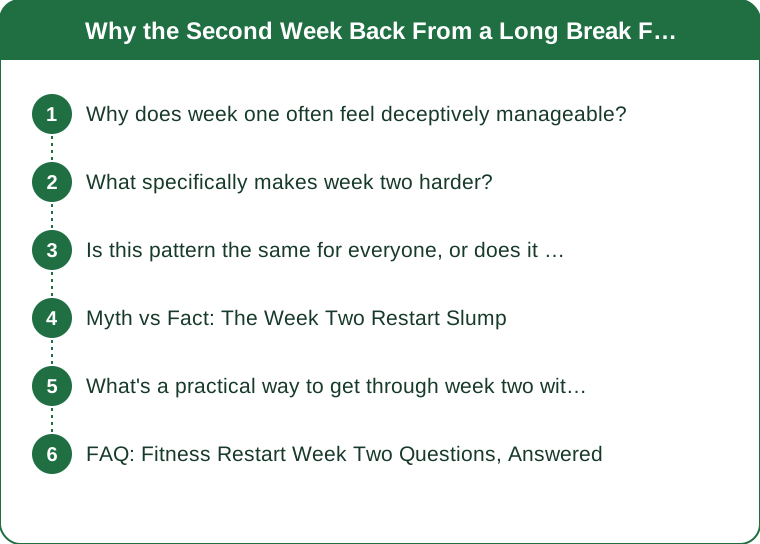
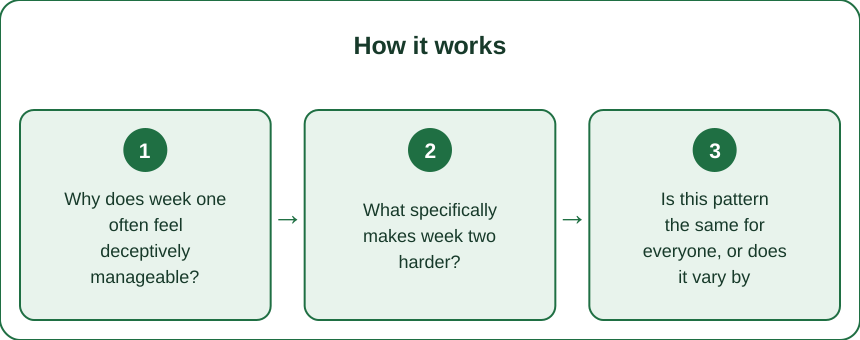
Why does week one often feel deceptively manageable?
Fresh motivation and the psychological lift of finally starting again tend to mask fatigue and effort perception during the first few sessions, and delayed onset muscle soreness typically hasn’t caught up yet — most of week one’s soreness shows up after it’s already over, meaning the week itself often feels better than the physical reality warranted.
What specifically makes week two harder?
By week two, accumulated soreness from week one’s sessions is now layering on top of new training demand, motivation has naturally settled from its initial peak, and the novelty that made early sessions feel exciting has faded — the combination of more physical fatigue and less psychological boost makes the same or even slightly easier sessions feel notably harder.
Is this pattern the same for everyone, or does it vary by fitness history?
It’s a fairly consistent pattern regardless of prior fitness level, though people returning after a longer break (several months or more) tend to feel it more intensely, since a longer layoff means more initial deconditioning and correspondingly more soreness accumulation heading into week two.

Myth vs Fact: The Week Two Restart Slump
Myth: feeling worse in week two means the program is too intense. Fact: for most people, this is an expected motivation-and-soreness dip, not a sign the plan needs to change.
Myth: pushing through at full intensity is the best way to prove commitment. Fact: slightly reducing volume or intensity in week two while maintaining consistency often preserves the restart better than grinding through at full effort.
Myth: if week two feels this hard, the whole restart is off track. Fact: week three commonly feels noticeably better as soreness catches up and settles, making week two a temporary dip rather than a trend.
What’s a practical way to get through week two without losing momentum?
Deliberately reducing intensity or volume slightly (not skipping sessions, just easing the demand) during week two specifically acknowledges the expected dip without abandoning consistency, and tends to preserve motivation better than either pushing through at full intensity or taking an unplanned break.
FAQ: Fitness Restart Week Two Questions, Answered
Does week three usually feel better than week two?
Yes, for most people — by week three, soreness from the accumulated first two weeks typically begins resolving while conditioning has genuinely started improving, producing a noticeable relative improvement.
Is it better to take an extra rest day during week two specifically?
Often yes — an additional rest day during the week two dip, planned rather than reactive, can meaningfully reduce how hard the week feels without disrupting overall consistency.
Should workout intensity be reduced for the whole first month, not just week two?
A gradual ramp across the first three to four weeks, rather than jumping straight to target intensity, tends to produce a smoother restart with less risk of the week two dip becoming a reason to quit entirely.
TL;DR:
- Week one often feels easier than it actually is due to fresh motivation and delayed soreness
- Week two combines accumulated soreness with lower novelty, making it feel objectively harder
- This pattern is common regardless of fitness background, more intense after longer breaks
- Slightly reducing intensity in week two, not skipping it, tends to preserve overall momentum
- Week three typically feels better as soreness resolves and conditioning improves
The week two slump is a predictable bump in the road, not a signal the restart isn’t working.
Keep Reading
This article is for general informational purposes only and is not medical advice. Always consult a qualified health professional for guidance specific to you.