Why the Second Week Back Into Fitness Often Feels Worse Than the First
Quick Answer: Week one often runs on motivation and adrenaline, which masks fatigue; by week two, accumulated muscle soreness and real tiredness catch up while the initial motivation high has faded, making the exact same workouts feel noticeably harder even though you’re objectively more conditioned than you were seven days ago.
Week one felt like proof you were finally back on track. Week two felt like your body forgot everything it just relearned — and that gap between the two weeks is more common than it seems.

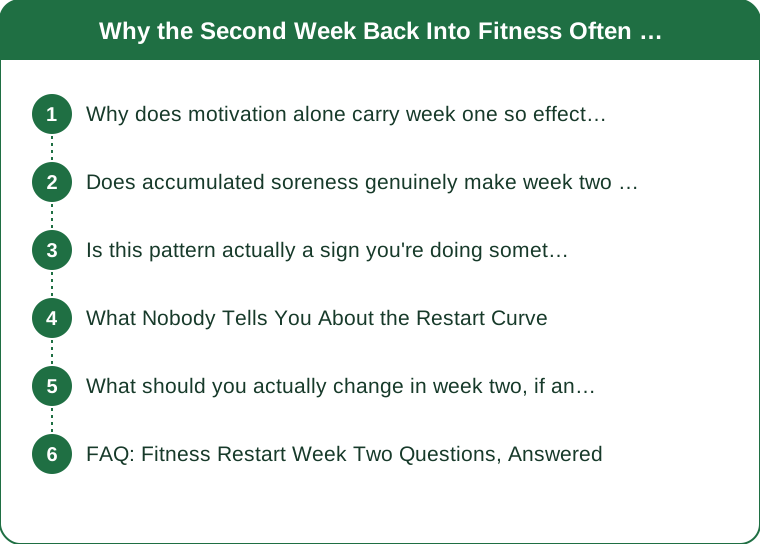
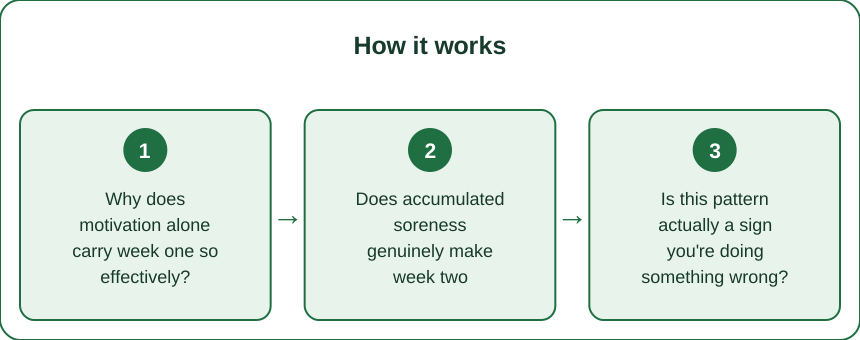
Why does motivation alone carry week one so effectively?
Starting something new triggers a genuine psychological and even physiological lift — novelty and a sense of accomplishment release dopamine that can mask fatigue signals your body would otherwise be sending. This isn’t fake or “just in your head” — it’s a real short-term effect that simply isn’t sustained past the first several days.
Does accumulated soreness genuinely make week two physically harder?
Yes — delayed onset muscle soreness (DOMS) typically peaks 24-72 hours after a workout, meaning week-one sessions are still generating soreness that layers on top of week-two sessions before your body has fully recovered from the initial shock of returning to activity. You’re training through more accumulated fatigue in week two than you were in week one, even doing an identical routine.
Is this pattern actually a sign you’re doing something wrong?
No — it’s a near-universal restart pattern, not a signal you overdid it or chose the wrong plan. Understanding it in advance is often enough to prevent people from quitting exactly when they hit this expected dip, mistaking a normal adaptation curve for evidence the plan isn’t working.

What Nobody Tells You About the Restart Curve
Week three is commonly where things start feeling noticeably better again, once initial soreness resolves and early conditioning gains kick in — people who push through the week-two dip without dropping intensity too far usually report a real turning point right around this point, not gradually over months.
Also underrated: slightly reducing intensity (not stopping) during week two — shorter sessions, lighter loads — while staying consistent tends to produce a smoother transition into week three than either pushing at full week-one intensity or taking extended time off.
What should you actually change in week two, if anything?
Prioritize recovery basics (sleep, hydration, some protein) more deliberately than in week one, since your body is doing real repair work on top of new training demand. A slightly lighter week-two session plan — not a skipped week — tends to bridge people through to the point where week three’s improvement becomes noticeable.
FAQ: Fitness Restart Week Two Questions, Answered
Should I take a full rest week if week two feels this hard?
A full week off usually isn’t necessary — reducing intensity while staying consistent tends to work better than stopping entirely, which resets the adaptation process further.
Does this pattern happen with every restart, or fade with experience?
It tends to happen with most true restarts after an extended break, though people with more overall training history sometimes recover faster within the same pattern.
Is it normal for motivation itself to dip in week two, not just physical energy?
Yes — the initial dopamine-driven motivation boost from starting something new naturally fades around this point, which is a separate but related factor from the physical fatigue.
TL;DR:
- Week one runs partly on motivation-driven adrenaline that masks real fatigue
- Muscle soreness accumulates and peaks into week two, layering on new training
- This dip is a near-universal, expected pattern, not a sign anything’s wrong
- A slightly lighter (not skipped) week two tends to bridge into a better week three
Keep Reading
This article is for general informational purposes only and is not medical advice. Always consult a qualified health professional for guidance specific to you.