Why Week Three Is Where Fitness Restarts Actually Fail
Quick Answer: Restarts collapse in week three because novelty has faded, soreness has accumulated, and the habit is not yet automatic — the three supports all disappear at once. Week one runs on enthusiasm and week two on momentum; week three requires the routine to survive on structure alone, which is precisely what most restart plans never build. Planning specifically for week three — lower volume, fixed times, and a minimum acceptable session — changes the outcome more than anything you do in week one.
Week one you felt fantastic and told people about it.
Week two you were sore but proud.
Week three, Wednesday, you skipped one. And that was that.

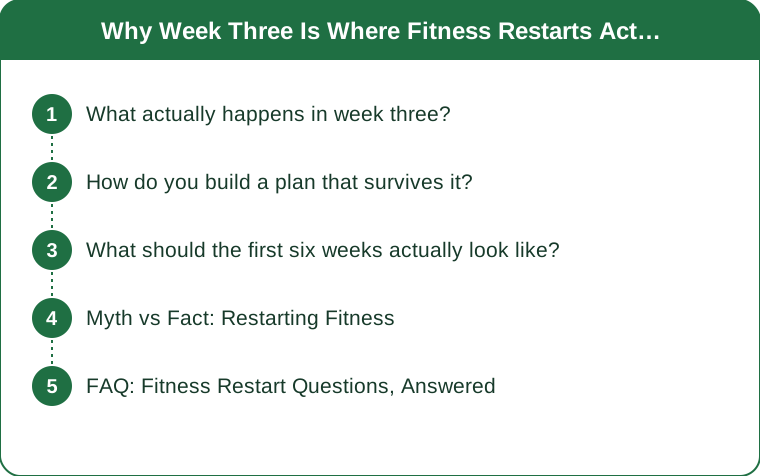
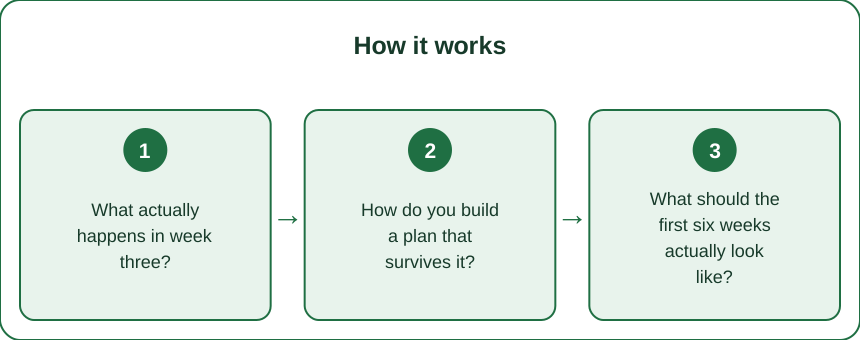
What actually happens in week three?
Three separate supports fail at approximately the same time.
Novelty has worn off. The dopamine of a new routine is genuinely front-loaded and fades within two weeks. What was interesting becomes ordinary.
Cumulative fatigue peaks. Two weeks of unaccustomed training produces real accumulated tiredness, especially if the plan was too ambitious.
The habit is not automatic yet. Behaviour automaticity typically takes considerably longer than two weeks — often two months or more. Week three sits in the gap.
Initial results have not appeared. Visible change takes six to eight weeks, so week three offers no external reward for the effort.
Life resumes. The first fortnight often coincides with a protected period. By week three, normal demands are back.
And the first missed session carries disproportionate weight. Missing one in week three feels like evidence the restart has failed, which makes missing the second one much easier.
How do you build a plan that survives it?
Design for week three from day one.
Start at half of what you think you can do. If four sessions feels right, plan two. The goal in weeks one to four is establishing the pattern, not the training effect.
Fix the times, not the sessions. Same days, same times, every week. Decision-making is what erodes, so remove the decision.
Define a minimum acceptable session. Ten minutes counts. A walk counts. The point in week three is preserving the pattern, and a short session preserves it perfectly.
Plan the week-three dip explicitly. Reduce volume that week deliberately. A planned easier week does not feel like failure; an unplanned one does.
Attach it to something existing. Habit stacking — after the school run, before the shower — is markedly more reliable than a standalone intention.
Track attendance, not performance. In the first eight weeks the only number that matters is whether you turned up.

What should the first six weeks actually look like?
Considerably less than most restart plans propose.
Weeks 1 to 2: two sessions weekly, 20 to 30 minutes. Deliberately easy. The aim is to finish wanting more.
Weeks 3 to 4: same two sessions, add a walk. Do not increase intensity in the week the plan is most fragile.
Weeks 5 to 6: three sessions, slightly longer. Only if weeks one to four were complete without struggle.
Expect soreness in week one and again when volume rises. Both are normal; the second is often more surprising than the first.
Do not test yourself early. Testing detrained tissue is where restarts turn into injuries, and an injury in week two ends everything.
Autumn note: September is the biggest restart month of the year outside January, and it has a genuine advantage — routines are re-forming anyway, so a new session slots into a schedule that is already being rebuilt. Anchor it now while the calendar is still soft.
Myth vs Fact: Restarting Fitness
Myth: it takes 21 days to form a habit. Fact: the figure comes from a 1960s observation about surgical patients and has no basis for exercise. Research suggests two months or more on average, with wide variation.
Myth: you should push hard while motivation is high. Fact: this is exactly what creates the week-three crash. Motivation is a poor foundation because it is not renewable on demand.
Myth: missing a session breaks the habit. Fact: research on habit formation finds that occasional missed days do not meaningfully affect the eventual formation of a habit. Consecutive misses do.
Myth: you have lost everything from your last attempt. Fact: previous training leaves lasting adaptations, including retained myonuclei. Every restart is genuinely easier than the first attempt.
Myth: you need a perfect plan. Fact: an adequate plan you follow beats an excellent plan you abandon in week three. This is not close.
Myth: more sessions are always better. Fact: two sessions completed for twelve weeks beats five sessions abandoned in three. The comparison is not between plans, it is between a plan and nothing.
FAQ: Fitness Restart Questions, Answered
How many sessions should I start with?
Two weekly. Almost everyone starts with more and almost everyone would be further along in three months if they had started with two.
What if I miss week three entirely?
Restart at week one volume. Missing a week is not a failure, and returning at the previous volume is the actual risk.
How long until it feels automatic?
Commonly two months or more, with substantial individual variation. The dip at week three is not evidence it will not happen.
Should I do the same workout every time?
Early on, yes. Familiarity removes decisions, and decisions are what erode in week three.
When will I see results?
Strength and energy changes at four to six weeks, visible changes typically eight to twelve. This is precisely why week three has no reward attached.
Is it worth restarting if I have failed before?
Yes, and it is measurably easier each time. Previous training leaves real physiological advantages that do not disappear.
This is general information, not medical advice.
TL;DR:
- Week three fails because novelty, momentum and reward all disappear before the habit is automatic.
- Start at half of what you think you can do — two sessions weekly, 20 to 30 minutes.
- Fix the times, define a minimum acceptable session, and plan a deliberately easier week three.
- Habits take two months or more, not 21 days, and occasional missed days do not break them.
- Track attendance, not performance, for the first eight weeks.
Put two fixed sessions in the calendar for the next six weeks and nothing else. The restraint is the whole strategy.
Keep Reading
This article is for general informational purposes only and is not medical advice. Always consult a qualified health professional for guidance specific to you.