Why Your First Two Weeks Back Should Have No Numbers in Them
Quick Answer: Numbers in your first two weeks back invite comparison with your previous self, and that comparison is the most reliable way to quit. Your only job in weeks one and two is to establish that you show up. Tracking frequency — did I go, yes or no — builds the habit without generating the discouraging data that a comeback cannot survive.
You are ready to start again and you are about to open a spreadsheet. Weights, paces, a weekly target, a starting weight.
That spreadsheet is the thing most likely to end this attempt by week three. Not because tracking is bad, but because tracking now produces exactly the wrong information at exactly the wrong time.
Here is what to do instead for fourteen days.

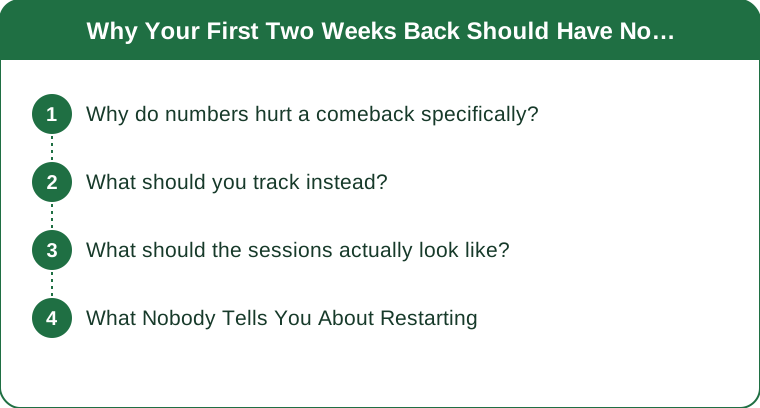
Why do numbers hurt a comeback specifically?
Because every number you record gets compared with a number you used to hit, and you will lose that comparison every time.
The reference point is your fittest self. You do not remember your average past session — you remember your best one. Your first session back is compared with a personal record set under ideal conditions, which is a comparison designed to disappoint.
Detraining is fast and real. Meaningful losses in aerobic capacity and strength occur within weeks of stopping. Seeing that quantified in your first week is accurate, useless, and demoralizing.
Early sessions should be deliberately easy. A good first two weeks is intentionally submaximal. If you are logging numbers, you have created a direct incentive to push harder than you should, which is how comebacks turn into injuries and two-week layoffs.
And the useful variable is not performance. In weeks one and two the only thing that predicts whether you are still training in month three is whether you showed up. Performance data is noise until the habit exists.
What should you track instead?
One binary per day: did I do the thing. Nothing else.
Use a calendar and a mark. A physical calendar with an X, or a single note in your phone. The visual chain of marks is genuinely motivating in a way that a declining performance graph is not.
Set an absurdly low bar. Twenty minutes of anything counts. The bar has to be low enough that a bad day still gets a mark, because breaking the chain is what ends attempts.
Count frequency, not quality. Four marks in a week is a great week regardless of what happened inside those sessions.
Then stop looking at it. Mark it and move on. This is not a dataset to analyze; it is a chain to keep unbroken.

What should the sessions actually look like?
Short, easy, and repeatable — deliberately well within your capacity.
Cap sessions at 30 minutes. Long sessions in week one produce soreness that costs you week two. Thirty minutes is enough to establish the habit and not enough to wreck you.
Stay at conversational effort. If you could not hold a conversation, it was too hard for these two weeks. Yes, even though it feels like nothing.
Keep the same two or three sessions. Novelty is the enemy of habit formation right now. Repeating the same walk, the same short strength circuit, the same class means fewer decisions and more repetitions.
Stop when you could do more. Finishing with something left is the single best predictor of coming back tomorrow. Ending a session while it still feels good is a technique, not a lack of ambition.
What Nobody Tells You About Restarting
Week two is harder than week one. Novelty carries you through the first week; week two is where the habit is actually tested. Knowing that in advance stops you from reading normal difficulty as failure.
Soreness peaks around day three or four. Plan the easiest session of the fortnight there. Most people schedule something ambitious and then miss it, which breaks the chain at its most fragile point.
Your old program is the wrong program. It was written for the fitness you had. Starting there is the most common comeback mistake and it usually ends with an injury or an abandoned week.
Bring the numbers back in week three. This is not anti-tracking. Once the habit is established, data becomes genuinely useful for progression — and by then the comparison stings much less because you have your own recent baseline.
Your fitness returns faster than it built. Muscle memory is real; previously trained people regain strength and capacity considerably faster than untrained beginners develop it. The reason to avoid numbers now is emotional, not physiological — and in two weeks the numbers will be much kinder.
This is general information, not medical advice. If you are returning after illness, injury, or a long absence, get individual guidance before starting.
TL;DR:
- Numbers in weeks one and two get compared with your fittest self, and that comparison is the main reason comebacks end.
- Track one thing: did I show up. A calendar and a mark, with an absurdly low bar.
- Cap sessions at 30 minutes, keep effort conversational, repeat the same two or three sessions.
- Stop while you could still do more — that is what makes you return tomorrow.
- Expect week two to be harder than week one, and put your easiest session on day three or four.
- Reintroduce numbers in week three, when they become useful instead of discouraging.
Your first two weeks back are not a training block; they are proof of concept. Take the numbers out and the only question left is the one that actually matters right now — did you go.
Keep Reading
This article is for general informational purposes only and is not medical advice. Always consult a qualified health professional for guidance specific to you.