Why Your Motivation Spikes Then Crashes in the First Week Back
Quick Answer: The early-week motivation spike comes from novelty and identity excitement (the ‘fresh start’ effect), which is a real but temporary psychological boost that isn’t designed to last, while the crash around day four to five happens as accumulated physical fatigue meets the natural fading of that novelty — both are predictable, not a sign of weak willpower.
Day one felt unstoppable. Day two, still good. Day four, the alarm gets silenced without a second thought — and it’s tempting to read that as proof the motivation was never real to begin with. It was real. It just was never built to carry the whole thing alone.

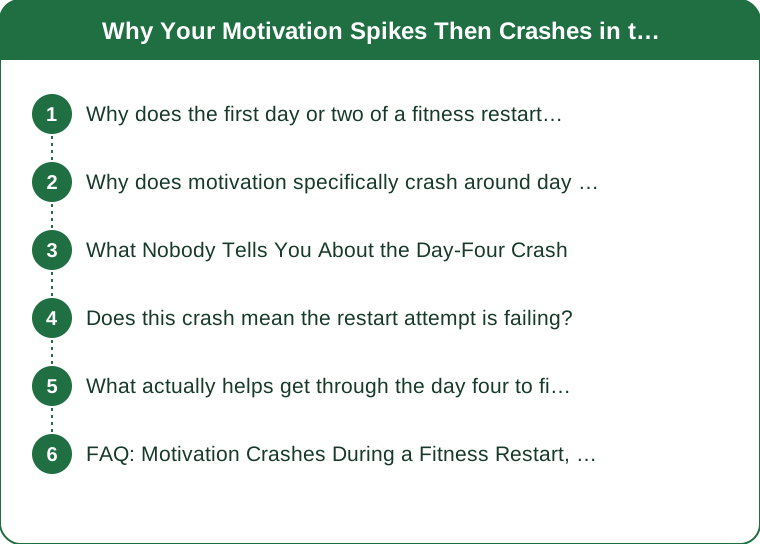
Why does the first day or two of a fitness restart feel so motivating?
Behavioral research on the ‘fresh start effect’ shows that temporal landmarks — a new week, a new month, a restart after a break — genuinely boost motivation and goal commitment in the short term, because they create a sense of a clean psychological slate separate from past setbacks, which is a real and useful phenomenon, just one that fades naturally as the days move further from that starting point.
Why does motivation specifically crash around day four or five rather than staying steady or declining gradually?
By day four or five, the novelty of the fresh start has faded while accumulated physical fatigue (soreness, disrupted sleep from a new routine, adjusting energy needs) has built up enough to become noticeable, and this combination — declining psychological novelty meeting rising physical fatigue — tends to create a sharper drop rather than a slow decline, which is why the crash often feels sudden rather than gradual.
What Nobody Tells You About the Day-Four Crash
Most fitness restart advice focuses on building willpower or motivation as if it’s a resource to stockpile at the start, but nobody tells you that relying on that initial motivation spike to carry the whole first week is structurally unlikely to work, because it’s a temporary psychological state, not a sustainable fuel source — the people who successfully get through week one aren’t the ones with more motivation, they’re usually the ones who built in systems (like a non-negotiable minimum, or a scheduled check-in) that don’t depend on daily motivation holding steady.

Does this crash mean the restart attempt is failing?
No — a predictable dip in motivation around day four or five is a normal part of the process for most people restarting after a break, not a signal the attempt itself is doomed; treating the crash as expected and having a lower-effort backup plan for that specific window (a shorter workout, a walk instead of a full session) tends to preserve the overall restart far better than treating the dip as proof of failure and quitting entirely.
What actually helps get through the day four to five window?
Lowering the bar specifically for that window — planning a shorter or easier session in advance for days four and five rather than expecting the same intensity as day one — reduces the all-or-nothing trap where a low-motivation day turns into a skipped day and then a fully abandoned restart; treating consistency (showing up in some form) as the goal for that specific window, rather than performance, tends to preserve the habit through the dip.
FAQ: Motivation Crashes During a Fitness Restart, Answered
Is the day four or five crash something that happens to almost everyone restarting fitness?
It’s a very common pattern tied to the fading fresh-start effect combined with early physical fatigue, though the exact timing varies somewhat person to person — some feel it by day three, others closer to day six.
Should workout intensity be deliberately reduced heading into that window?
Planning a lighter or shorter session for days four and five in advance, rather than waiting to see how motivation feels that day, tends to prevent the all-or-nothing skip that often follows an unplanned low-motivation day.
Does experiencing this crash mean future restart attempts will go the same way?
Not necessarily — recognizing the pattern and planning around it (rather than being caught off guard) tends to make each subsequent restart attempt more resilient through that specific window, even if the underlying motivation dip itself still happens.
TL;DR:
- The early motivation spike comes from a real but temporary ‘fresh start’ psychological effect
- The day four to five crash happens as that novelty fades while physical fatigue accumulates
- This dip is a normal, predictable pattern, not proof the restart attempt is failing
- Planning a lighter session for that specific window helps preserve consistency through the dip
The motivation crash isn’t a character flaw showing up on day four — it’s a predictable psychological and physical pattern, and building a plan around it beats waiting to see if willpower shows up that day.
Keep Reading
This article is for general informational purposes only and is not medical advice. Always consult a qualified health professional for guidance specific to you.