Why Your Old Program Is the Wrong Place to Restart
Quick Answer: Detraining affects different systems at different rates — cardiovascular fitness declines faster than strength, and connective tissue adapts more slowly than muscle in both directions. Restarting at your previous volume overloads the slowest-adapting tissue first, which is why comebacks so often end in an injury rather than a plateau.
You know the program. It worked. You still remember the weights. Starting there is the single most reliable way to be sitting out again by week four.

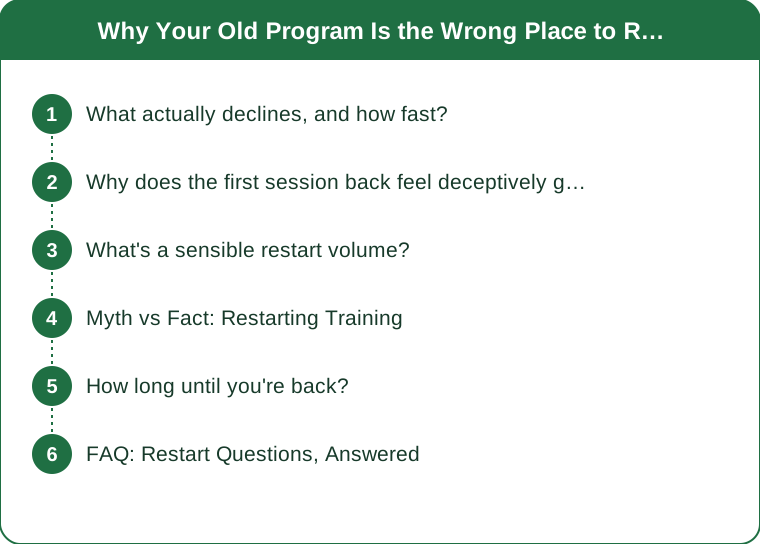
What actually declines, and how fast?
Not uniformly, which is the whole problem. Cardiovascular adaptations decline relatively quickly — measurable reductions in aerobic capacity appear within a few weeks of stopping.
Strength is retained considerably longer. Neural adaptations in particular persist well, which is why the weights often feel more manageable than expected on the first session back — and why that first session is so misleading.
Connective tissue is the slow one in both directions. Tendons and ligaments adapt more slowly than muscle when training, and lose capacity on their own timeline when you stop. That mismatch is the actual mechanism behind most comeback injuries: your muscles can produce force your tendons aren’t ready to transmit.
Why does the first session back feel deceptively good?
Because strength retention plus muscle memory means you can often produce close to previous force outputs. The nervous system remembers the pattern.
What it doesn’t tell you is anything about tissue tolerance for volume. You can typically lift near your old weights and be nowhere near ready for your old volume, and volume is what accumulates into injury. The first session’s feedback is about the wrong variable entirely.
What’s a sensible restart volume?
A commonly used approach is starting at roughly 50-60% of previous volume and building back over four to six weeks, with the exact figure scaling to how long the break was.
Concretely: if you were doing four sets per exercise, start with two. If you were running 20 miles a week, start at 10. Hold that for a full week before increasing, and increase by about 10% weekly. It feels absurdly conservative in week one and completely reasonable by week four, when the people who started at full volume are dealing with a strained something.

Myth vs Fact: Restarting Training
Myth: You lose everything after a few weeks off. Fact: Strength and muscle memory persist substantially. Retraining is consistently faster than initial training was.
Myth: Soreness after the first session means you’re back to zero. Fact: Soreness reflects novelty, not lost fitness. It fades within two or three sessions as the repeated bout effect kicks in.
Myth: You should train harder to catch up. Fact: The rate-limiting factor is tissue adaptation, which doesn’t accelerate with effort. Trying to compress it is the mechanism of the injury, not a shortcut around it.
Myth: Muscle turns to fat during a break. Fact: They’re different tissues and neither converts to the other. Muscle size decreases and body fat may increase, but that’s two independent changes.
How long until you’re back?
For breaks of a few weeks to a few months, most people find they return to previous levels considerably faster than it took to build them originally — muscle memory is real and well documented at the cellular level.
A rough expectation: a break of one month often takes two to three weeks to recover from; a break of six months might take two to three months. The ratio is favorable, which is worth knowing because the fear of having lost everything is what drives the too-fast restart in the first place.
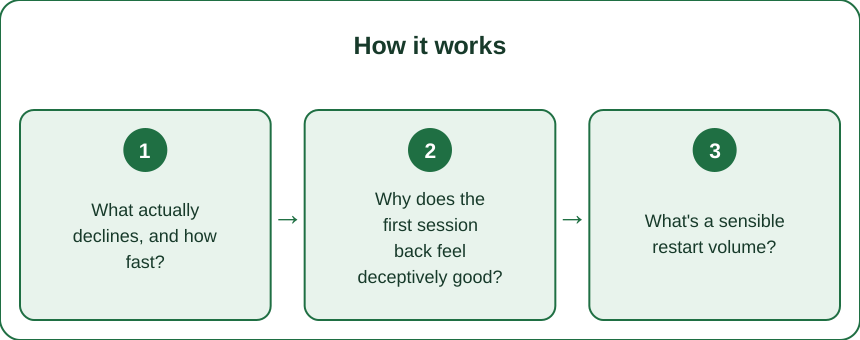
FAQ: Restart Questions, Answered
Should I retest my maxes when I come back?
Not in the first few weeks. Maximal testing loads exactly the tissue that’s least ready, and the number won’t inform the plan more than a conservative estimate would.
Does it matter why I stopped?
Yes, considerably. A break due to injury or illness needs a different and usually slower approach, and often professional guidance. A break due to schedule or travel is the straightforward case.
Is it better to restart with the same program or a new one?
The same program at reduced volume is usually the cleanest option — familiar movement patterns mean less novelty-driven soreness on top of the retraining load.
TL;DR:
- Cardio declines fast, strength persists, connective tissue adapts slowest in both directions
- The first session feels good because strength returns before tissue tolerance does
- Start at roughly 50-60% of previous volume and build 10% weekly
- Retraining is meaningfully faster than the original build — muscle memory is real
- A break due to injury or illness needs a different, slower plan and usually a professional
The comeback that lasts starts lower than your ego wants. Four weeks from now that’s invisible; a strained tendon isn’t.
Keep Reading
This article is for general informational purposes only and is not medical advice. Always consult a qualified health professional for guidance specific to you.